
International flight guide
Flying to the Bahamas by private airplane
Researched by Taxi to Table · Guide checked
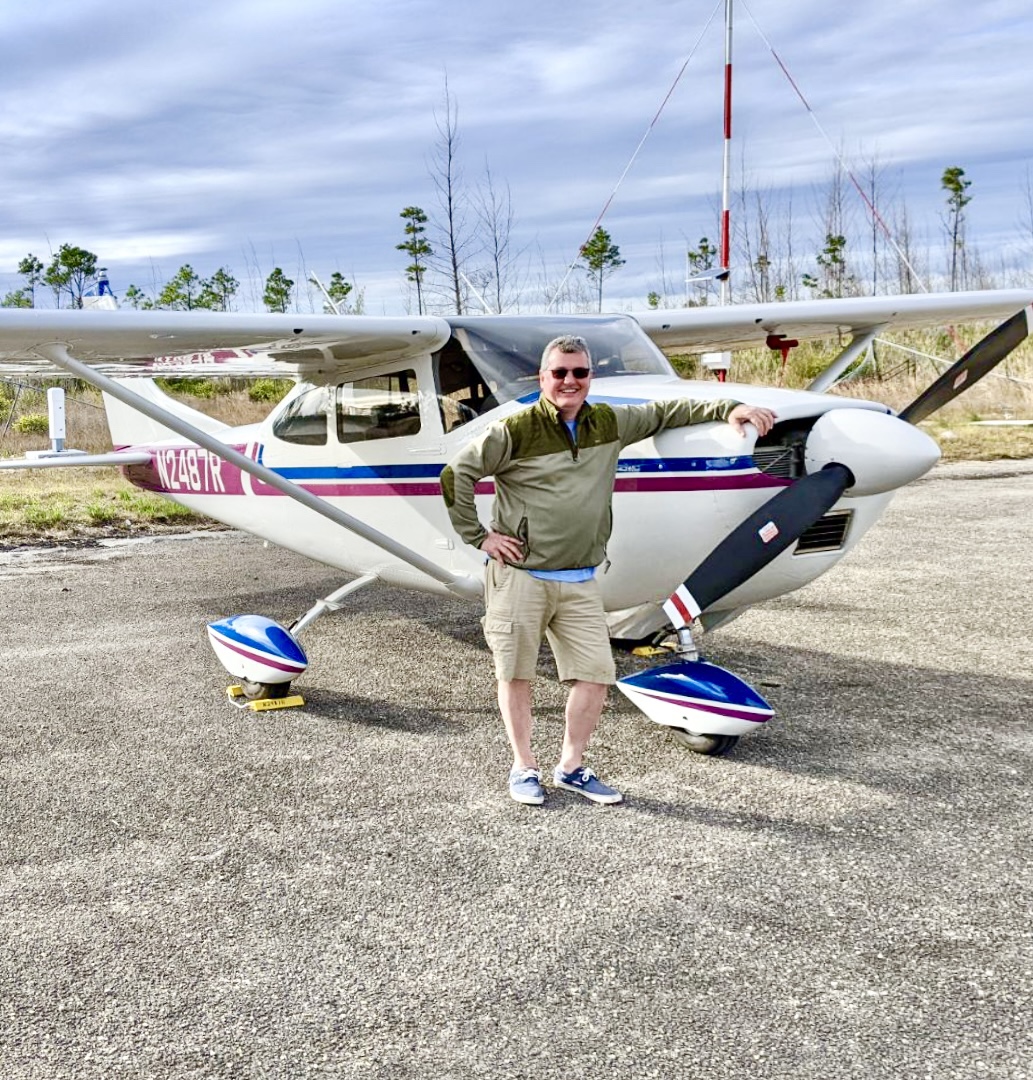
In the photo from Fresh Creek, Sean is standing beside Mabel, his 1964 Cessna 182G. That’s the part of a Bahamas flight you bring home: you took your own airplane to an island. The question that makes the trip work comes a little earlier. When you shut down, where exactly do you and your passengers go next? This guide follows a privately operated, U.S.-registered piston airplane on a recreational round trip from Florida. Use current AIP information, NOTAMs, a weather briefing and instructions from both ports for your flight.
Choose your islands
Start at the far end of the ferry ride
If you want to spend the afternoon in Hope Town, open the ferry timetable before you draw a line on the chart. Your airplane will be in Marsh Harbour. Between the two are an inspection, a tiedown, a taxi and a boat. Work backward from the last sailing you would be comfortable catching. Now you have something more useful than a distance on a screen: a morning departure window and a reason to stay overnight if it slips.
A shorter first crossing · MYBS
South Bimini Airport is a Bahamas Customs airport of entry about 57 nautical miles direct from Fort Lauderdale Executive. It offers a single-island alternative with a shorter overwater leg. For North Bimini, arrange a taxi from the airport to the South Bimini ferry dock and a boat across.
- South Bimini Airport +1 242-347-4111. Confirm customs hours, parking and fuel. Plan to make the next verified fuel stop with reserve if no fuel uplift at Bimini is confirmed.
Marsh Harbour · MYAM
Leonard M. Thompson International Airport on Great Abaco is a Bahamas Customs airport of entry. Cherokee Aviation has Customs and Immigration in its FBO building and advertises avgas and Jet A.
- Cherokee Aviation +1 242-367-1900. Abaco Airport Customs +1 242-367-2026. Confirm the clearance time, fuel grade, quantity and parking for your aircraft.
- For Hope Town on Elbow Cay, take a land taxi to the Crossing dock in Marsh Harbour, then a passenger ferry. Check the sailing and the arrival dock with your accommodation before leaving the airport.
- On Elbow Cay, the Elbow Reef Lighthouse Society publishes visitor instructions for the working lightstation. Confirm which side of Hope Town harbour your ferry serves and how to cross back in time for the last boat.
North Eleuthera · MYEH
North Eleuthera International Airport is a Bahamas Customs airport of entry and the air gateway to Harbour Island. White Crown Aviation lists Customs and Immigration on site, tie-downs, 100LL and Jet A.
- White Crown Aviation +1 242-335-1650, FrontDesk@WhiteCrownAviation.com. Ask the FBO to confirm officer availability for your planned arrival or departure and the fuel available that day.
- For Dunmore Town, take a taxi to Three Island Dock, then a water taxi to Harbour Island’s Government Dock. Ask about the last crossing and arrange the return transfer before committing to your departure time.
Fresh Creek on Andros
The photograph above was taken at Fresh Creek Airport, the gateway to Andros Town. Arrange a driver for both legs before flying. A morning batik visit and lunch can work as a day out if your inspection, fuel and daylight windows allow.
- Androsia Batik offers factory visits and batik lessons in Fresh Creek. Ask about opening days and reserve a lesson if you want to make your own fabric.
- For a meal, Small Hope Bay Lodge publishes lunch and dinner options. Ask whether day visitors can reserve, what the meal costs and how to arrange transport back to the airport. Treat it as a ground excursion.
Three flying days from Fort Lauderdale
These approximate airport-to-airport great-circle distances illustrate the scale of the trip. Calculate actual track, flight time, fuel, alternates and reserves for the aircraft, weather and airspace on the day.
- Day 1 · Fort Lauderdale Executive (KFXE) to Marsh Harbour (MYAM), about 167 NM. Plan daylight arrival during the agreed customs window. Clear the people and aircraft, retain the endorsed cruising permit and confirm fuel before taking the ferry to Hope Town.
- Day 2 · Marsh Harbour (MYAM) to North Eleuthera (MYEH), about 66 NM. Carry the endorsed permit. Recheck weather, airspace, flight-plan requirements and operating notices. Tie down at North Eleuthera and transfer by taxi and boat to Harbour Island.
- Day 3 · North Eleuthera (MYEH) to Fort Lauderdale Executive (KFXE), about 193 NM. Complete Bahamas departure formalities at MYEH. Submit the inbound U.S. manifest and obtain permission to land from the appropriate U.S. port before leaving. Use KFXE only if it qualifies for your actual crossing under the first-landing rule or your overflight exemption. For KFXE, call CBP at +1 954-491-5647. Reconfirm permission if the ETA or port changes. Allow an extra night if the crossing weather closes in.
Before booking
Choose a staffed airport of entry
Make the first Bahamian landing at a designated airport of entry and book clearance there. Depart the country from a designated airport of entry as well. Give the Customs office the aircraft registration, origin, date, ETA with time zone, number aboard and recreational purpose. Ask how much advance notice it needs, where to park, when both Customs and Immigration can attend, and how to advise a delay or diversion. A directory listing alone does not confirm officers are on duty.
- A standard private flight without compensation ordinarily needs no CAA-B operating permit. A seaplane landing requires separate approval. For a privately operated strip, arrange airport-owner permission when required.
- Ask whether the airport needs a separate arrival report. Tourism identifies Nassau and Freeport, plus some other airports for twin-engine aircraft. Request the current form and submission method from the port.
- Useful contacts include Nassau airport Customs at +1 242 604 3271 and cust_lpia@bahamas.gov.bs, and Customs headquarters at +1 242 604 3124. For other islands, ask the airport for its Customs officer’s direct number.
What to ask when you call
Give the aircraft type, registration, operating weight, dates, local ETA, fuel grade and gallons needed. Ask which ramp to use for inspection and who will meet the aircraft.
- Request an itemized quote for any landing, handling, parking, tie-down, fuel and passenger charges. Ask which government charges are included, whether a fuel purchase waives handling, what payment methods work and what an additional night would cost.
- Confirm fuel and inspection availability again on departure day. Use current aerodrome information, applicable amendments, charts and NOTAMs to verify runway condition, operating hours and any restrictions. Check last boat, baggage allowance and return pickup independently.
Check pilot, aircraft and policy before booking
This checklist assumes a privately operated U.S.-registered standard-category piston single. Verify pilot certificate, ratings, flight review, passenger currency and IFR currency if applicable. Carry a valid passport book, appropriate FAA medical and required FCC radiotelephone operator permit. AOPA and the Bahamas tourism authority describe BasicMed acceptance, backed by a 2017 CAA-B letter. A later, narrower light-sport/ultralight exemption expired June 30, 2026. Ask CAA-B for current terms for your aircraft and dates if relying on BasicMed, especially outside the original U.S. limits.
- Carry the aircraft registration valid for international operations, airworthiness certificate, onboard operating limitations/POH and current weight-and-balance information, and FCC aircraft station license. Bahamas §2A.424 also lists the journey log, passenger names with embarkation and destination, and cargo manifest/declarations when applicable. Verify ID plate, 12-inch registration marks for ADIZ crossing, altitude-reporting transponder, and ADS-B for the U.S. airspace to be used.
- Obtain written international permission from the owner, lender, club or rental company where applicable. Confirm coverage in writing for this pilot, airplane, overwater route and island destinations. Check passenger liability, hull, off-airport recovery, exclusions, deductibles and claims contacts. Save the certificate, authorizations and insurer’s emergency number offline. Verify special airworthiness validation separately for experimental or other special-category aircraft.
- Confirm each traveler’s passport book and visa or reentry documentation for their nationality and status. For a child traveling with one parent or another adult, carry dated notarized consent from absent legal guardians or applicable custody documentation. Match names and identifying details to the manifests. Weigh baggage and survival gear, verify the loaded center of gravity and performance on both legs, and secure baggage clear of the exits.
Prepare the U.S. border paperwork
These steps cover a private, noncommercial flight in a U.S.-registered airplane between Florida and The Bahamas. CBP applies different procedures when passengers or cargo are carried for payment or other consideration.
- Enroll in CBP eAPIS and confirm you can sign in and receive its email before the trip. Submit one departure manifest and one arrival manifest. You can file the return before leaving home once the people, aircraft, dates and route are known.
- Compare each person’s travel document to their face and the data you enter. Include the pilot, any other crew and every passenger, including children and lap infants. Have each U.S. citizen’s valid passport book available. Confirm both countries’ entry documents for travelers of other nationalities. U.S. Visa Waiver Program travel by air normally requires a participating carrier. Check eligibility directly with CBP before carrying someone relying on ESTA.
- Gather registration and aircraft details, owner/operator and pilot details, a 24-hour emergency contact, addresses, the foreign airports on the applicable 24-hour itinerary, and the estimated time and place of U.S. border or coastline crossing. Enter times in the zone requested by each field.
- Buy the aircraft-specific CBP decal for the calendar year of the U.S. return through DTOPS. The current fee is US$38.04, effective October 1, 2026. If paid and awaiting delivery, enter “receipt” in the APIS decal field, tell the arrival officer when seeking permission to land and carry the electronic or printed order history or receipt.
- CBP eAPIS • enroll or submit a manifest
- CBP • private aircraft manifests and changes (19 CFR 122.22)
- CBP • general aviation processing FAQs
- DTOPS • purchase a private aircraft decal
- CBP • private aircraft user fee effective October 1, 2026
- CBP • traveler documents for U.S. citizens
- CBP • Visa Waiver Program and signatory carriers
Budget the border and airport charges
For an eligible C7A pleasure flight, budget B$150 per aircraft on entry. Customs lists the recreational charge as inward only. The B$50 amount still displayed on the tourism pilot page predates the fee change. The fee schedule assigns seat-based inward and outward charges to charter aircraft.
- Budget B$29 air departure tax for each traveler age six or older, including the pilot, plus the B$2 tourism enhancement levy for applicable travelers. For two adults, Customs processing, departure tax and tourism levy total B$212. Add airport and operator charges to this figure.
- Ask the airport and FBO for landing, parking, handling, passenger, security or after-hours charges and applicable tax. Ask Customs and the FBO separately which cards or cash they can take. Bring suitable cash and a card, especially on the Family Islands, and keep itemized receipts.
- BANSA’s published exemption includes aircraft operated by private users with a single piston engine. Confirm current air-navigation charges for other aircraft with BANSA. Airport and handling charges have separate schedules.
- Bahamas Customs · processing fee table and office numbers (PDF)
- Bahamas Official Gazette · aircraft Customs fees, S.I. 32 of 2024
- Office of the Prime Minister · air departure tax and tourism levy
- Airport Authority · airport fee schedules
- Bahamas Air Navigation Services Authority · charges and exemptions
- Bahamas Ministry of Tourism · pilot procedures and forms
Special operations and repeat visits
Experimental and other special-category aircraft, seaplanes and flights relying on sport privileges may need different permissions. Check the current Civil Aviation Authority Bahamas (CAA-B) notices and obtain any required authorization before crossing. For BasicMed, see the pilot-document section above.
- A Frequent Digital Cruising Card is an optional B$2,000, two-year program for qualifying propeller-powered aircraft, linked to registration. Every arrival still requires Customs clearance. Ask Customs which fees are covered, including the special charge for the sixth passenger and each additional passenger.
- Bahamian law applies its advance passenger information obligation to commercial carriage for monetary gain. CARICOM’s transition to MDEX changed the regional filing channel. Confirm classification with Immigration if anyone is paying, the purpose is business, or another country is on the route.
- Civil Aviation Authority Bahamas · private operating permits
- CAA-B · published industry notices and exemptions
- CAA-B · 2025 Basic Medical exemption and expiry (PDF)
- Bahamas Ministry of Tourism · pilot procedures and forms
- Bahamas Official Gazette · Frequent Digital Cruising Card, regulation 78A
- Bahamas · Advance Passenger Information System Act, sections 2–4 (PDF)
- CARICOM IMPACS · transition to MDEX
Plan the overwater legs
Let the person in the right seat try it
Before loading the bags, sit in the parked airplane with your passenger and the equipment you actually intend to carry. With the belt fastened, can each of you reach the raft or the beacon assigned to you? Can your passenger find the door latch without looking at your hands? A five-minute rehearsal on a quiet ramp can reveal that the one item you need first is buried under somebody’s overnight bag. Repack there, while the doors are open.
Plot the water you actually cross
On current charts, compare the direct track with one that stays near suitable landing areas. Mark the coast-out and coast-in points, each usable airport and the longest stretch outside gliding range. A shallow bank may look like land on a map. Identify a surface on which this airplane could actually make an emergency landing.
- Use the airplane’s POH/AFM glide chart at the intended weight, configuration and height above the landing surface. Account for headwind, turns, descent to landing and uncertainty. Plot the departure climb and arrival descent as well as cruise. An EFB glide ring is an estimate.
- Choose an altitude compatible with airspace, cloud clearance, pilot proficiency, performance and oxygen requirements. Agree on a decision point before coast-out and a diversion on either side of the crossing. Make the crossing in daylight with a discernible horizon and enough daylight to divert.
Give weather and sea state separate checks
Obtain a route briefing before departure and refresh it before crossing the shore. Use observations, TAFs where available, SIGMETs, satellite and radar trends, winds aloft and pilot reports. Check when each report was issued and which stations actually cover your route.
- Inspect showers, embedded thunderstorms, fronts, crosswinds and low cloud along the entire route, including both alternates. Offshore haze can erase the horizon in otherwise reportable VFR. If conditions close the gap to your escape route or exceed a personal limit, delay or turn toward the usable alternate while it is reachable.
- Compare the NOAA marine forecast for the Straits of Florida and relevant Bahamas zone. Wind, swell, sea state and visibility matter to raft boarding and to rescuers. Consult Bahamas Meteorology and National Hurricane Center outlooks during tropical activity. Datalink imagery is delayed and coverage can disappear offshore. Use it to avoid areas of convection.
Build daylight into the island legs
Bahamian rules prohibit night VFR. Even an instrument-rated pilot needs to check the particular aerodrome’s operating restrictions, lighting, approvals, weather and available services before proposing a night IFR flight. For a first island trip, plan daylight for arrival, any diversion, customs and the ground transfer.
Buy fuel margin before it becomes a diversion
Call the destination and alternate fuel providers on departure day. Ask whether the exact approved fuel grade is in stock, the truck or pump is working, and what hours and payment methods apply. An airport symbol or a published supplier does not confirm today’s stock.
- Measure usable fuel before launch. Use POH climb and cruise flow, forecast winds and actual loads. Budget taxi, climb, destination, deviations, missed approach if applicable, diversion and a protected final reserve. Recheck time, groundspeed and fuel against the plan at coast-out and each decision point.
- For this size of airplane, Bahamas CAR OPS 2A.211 sets 30 minutes final reserve after a day-VFR destination, or 45 minutes after the IFR destination and any required alternate, with weather and expected delays included. U.S. §§91.151 and .167 also apply as appropriate. Choose a personal landing reserve above the applicable legal minimum, for example 60 minutes, and divert while that reserve is protected.
- For IFR, check Bahamas §2A.209 and FAA §91.169. The Bahamian exceptions to planning an alternate have local runway/approach or isolated-aerodrome conditions. Confirm runway availability, weather, approach status, fuel, opening hours, daylight and border arrangements for each diversion. If safety requires a different landing, advise ATC and the appropriate border authority as soon as practicable.
What belongs within arm’s reach
Choose and fit serviceable aviation-appropriate flotation for each occupant before the crossing. For an inflatable vest, brief manual inflation outside the aircraft. Use equipment expressly approved for each child’s size and weight. Bahamas Tourism specifies a U.S. Coast Guard–approved jacket per person. Check the approval label and fit, including the manufacturer’s child or infant limits. Keep the raft accessible from the cabin and secure it against movement. A raft packed under baggage may stay with the airplane.
- The U.S. for-hire equipment provision in §91.205(b)(12) and Subpart F §91.509 have limited applicability. Use Bahamas CAR OPS 2A.409 and .411 for the local GA provisions. The latter measures distance from land suitable for an emergency landing against the lesser of 50 NM or 30 minutes at normal cruise. Once that threshold is exceeded, it requires individual flotation, a survival-risk assessment and, based on that assessment, raft capacity for all occupants, survival gear and distress signaling. For this guide, carry the raft on every crossing.
- Check raft rated capacity, inspection dates, boarding aid, painter and equipment instructions. Add drinking water, sun protection, a mirror or strobe, whistle, first aid and a waterproof handheld aviation radio. Place a GNSS-equipped personal locator beacon (PLB) on a person with a safe attachment per its instructions. Register U.S.-coded beacons with NOAA and update emergency contacts.
- CAA-B §2A.417 specifies 121.5 and 406 MHz together. It lists a carried survival ELT or PLB option for aircraft certified for six or fewer passenger seats. Verify the aircraft’s ELT installation, inspection and battery separately under FAA §91.207, and verify the chosen beacon’s technical specifications. A satellite messenger can supplement a registered distress beacon.
Rehearse evacuation with the people going
Before engine start, have each passenger show how they would undo their belt and open the primary and alternate exit. Fit inflatable aviation jackets uninflated. Show the inflation handle and oral tube, and explain that an inflated jacket can trap someone in the cabin. Inflate after exiting. Assign an adult to each child or passenger needing assistance.
- Point out the raft, its securing device and painter, and the location and operation of the beacon and radio. Assign who can bring each item without blocking an exit. Follow the raft’s deployment and boarding instructions and brief how to account for everyone. Demonstrate with intact or training equipment. Leave bags behind during evacuation.
- Review the specific POH/AFM ditching checklist. If distress develops, fly the airplane and use that checklist. When workload permits, tell ATC the aircraft ID, problem, position, altitude, persons aboard and intentions. Use the current frequency or 121.5 MHz if needed. Brief a shore contact on the route, ETA, overdue action and who to call. A hands-on egress or water-survival session lets passengers and pilots practise in a controlled setting.
Depart Florida and clear into the Bahamas
Prepare the aircraft declaration
The pilot signs Customs form C7A only for an entirely recreational flight with no cargo, payment to the pilot or business purpose. Record the arrival details, aircraft registration, crew and passenger counts, and the declarations the form requests. Carry three paper copies. The form accepts two at Nassau, West End and Freeport. Keep a stamped copy and check the validity period entered by the officer.
- Click2Clear is the Customs electronic processing system. AOPA received a postponement of the private-pilot rollout in 2022. The government’s pilot checklist still uses C7A. Confirm the submission channel at the actual port and carry the paper set even when the port requests advance electronic details.
- Agree on the notice deadline before takeoff. If Customs directs you to use an inward C7, its 2024 fee rule applies a special rate where that report arrives less than an hour before landing. The rule lists C7 flight categories separately from C7A. Ask the officer before applying charter conditions to a leisure flight.
Prepare everyone for Immigration
Each person, including a child, needs an individual passport book. Check the visa rules for each nationality before leaving. The Bahamas Immigration Department publishes a six-month passport-validity rule, while the Bahamian embassy describes an exception for U.S. passport holders. Anyone with a shorter remaining validity should confirm acceptance with Immigration before departure.
- Bring the address or confirmed booking for the stay, evidence of funds and evidence of onward travel. For return by private airplane, prepare a pilot letter and itinerary giving the registration, names aboard, intended exit airport and date. The Immigration officer records the allowed stay.
- If only one parent accompanies a child, carry notarized consent from the other parent or relevant custody documentation. For a non-parent escort, the guardians’ notarized letter must authorize both travel and obtaining medical care.
Complete the traveler declaration
The government Digital Arrival Card combines immigration and baggage information. It has a private-aircraft/pilot entry and permits one submission for a qualifying family living in the same household. Enter each traveler, check names and passport numbers, and save the submission confirmation offline.
- The portal directs visitors to complete the digital card. The Ministry’s rollout notice described selected flights and continued paper processing. Confirm the procedure for your GA arrival with the local Customs and Immigration offices. Where paper is used, complete one immigration card per person, keep the departure stub and make the required C17 baggage declaration.
- The Exempt service handles the traveler’s C17. C7A covers the airplane. U.S. eAPIS covers the U.S. border crossing. Keep the respective confirmations available for inspection.
Before leaving the United States
Transmit the U.S. departure manifest at least 60 minutes before takeoff for The Bahamas. File early enough to resolve a rejected submission.
- Use the last U.S. departure point and the actual first airport in The Bahamas. A private flight may depart a U.S. airport without a CBP office. If it is missing from the eAPIS menu, select the nearest CBP-listed airport, enter the actual city, and identify the real field under Actual Departure Location Description.
- Read the CBP response and follow every instruction, including any request to report for inspection. Depart only after the message explicitly clears departure and the applicable timing requirement is met. A transmission number alone confirms delivery. A routine cleared private departure does not require calling the U.S. departure office.
- File the international IFR or Defense VFR (DVFR) flight plan separately. Identify the Bahamian airport of entry, verify customs arrangements, and arrange flight-plan activation. Save the CBP response offline.
Cross the U.S. coastal ADIZ in either direction
Plan the charted Air Defense Identification Zone (ADIZ) crossing separately from the U.S. border or coastline field on the CBP manifest. Check current charts, frequencies, NOTAMs and TFRs. U.S.-registered aircraft penetrating the ADIZ need nationality and registration marks at least 12 inches high, permanent or temporary.
- File an ICAO IFR plan or designate the VFR plan as DVFR. On DVFR, include the estimated UTC crossing time and point in Item 18, using coordinates or a fix/radial/distance. Confirm transmission and activate with U.S. Flight Service before entering. On IFR, obtain and operate under the ATC clearance. Keep the proposed departure time current. The FAA AIM calls for departure within five minutes of the estimate.
- Establish and maintain two-way radio communication. Before entering, squawk the assigned discrete code with altitude reporting in either direction. 1200 and anonymous UAT mode are prohibited in the contiguous U.S. ADIZ. Check the chart for usable frequencies along your particular route.
- On DVFR, before entry report time, position and altitude at the last reporting point and ETA at the next point. If the route has no suitable reporting point, report estimated crossing time, position and altitude at least 15 minutes before entry. If departure is too close to allow either report, report immediately after takeoff with departure time, altitude and ETA at the first reporting point. On IFR in controlled airspace, make the reports ATC requires.
- Notify the appropriate facility before deviating from a DVFR plan. At destination, confirm flight-plan closure with the responsible facility, particularly for VFR or an untowered destination. Handling a customs inspection does not close a flight plan.
- Copy the current frequencies and backup phone numbers for your actual route from the FAA and Bahamas AIPs. Confirm the agency that will close your flight plan at the destination, particularly for an untowered arrival.
Clear in, fly between islands, clear out
At the agreed ramp, follow the officers’ instructions for passengers and baggage. Present passports, the C7A and the traveler declarations, pay the applicable charges, and wait for both Customs and Immigration to release the flight before continuing.
- Carry the stamped C7A on every domestic stop and show it when requested. It serves as the inter-island cruising document for a qualifying pleasure flight. Check private-strip permission, fuel, weather, communications and airspace for each leg. File for Nassau airspace, including an inter-island arrival. A flight plan and overdue procedure are prudent for overwater legs.
- Before the international return, arrange outward clearance at a staffed airport of entry. Present one outward C7, surrender the stamped C7A, hand in any paper immigration departure stubs and pay the applicable departure charges. Retain a photo or receipt. Complete the separate U.S. arrival and flight-plan steps before launch.
Return to the United States
Select the first U.S. landing
On a normal unprecleared private return from The Bahamas to Florida, 19 CFR 122.23–122.24 requires first landing for inspection at the §122.24(b) airport nearest the planned border or coastline crossing point. Examples on the Florida list include Fort Pierce (KFPR), Fort Lauderdale Executive (KFXE) and Miami-Opa Locka (KOPF).
- Use the §122.24 list and the CBP airport fact sheet together. An airport may have customs services and still require a valid border overflight exemption for your route. A border overflight exemption must already cover the operation and its conditions. Even with the exemption, obtain permission to land from the U.S. arrival port before taking off.
- Check the port’s inspection hours, phone, lead time, ETA tolerance, assigned parking and special conditions. Have a suitable alternative and its port contact details ready. Plan time for both customs offices, fuel and weather delays.
Before taking off from The Bahamas
Transmit the U.S. arrival manifest at least 60 minutes before takeoff from The Bahamas. After transmission, call CBP at the intended U.S. first landing and obtain explicit permission to land before departure.
- Give the tail number, foreign departure, intended U.S. airport, date, ETA with time zone, and people aboard. Confirm the accepted ETA, permitted window, parking and inspection instructions. Record the officer’s name or identifier if provided. The eAPIS receipt, a filed flight plan, an ATC clearance or a voicemail do not grant this permission.
- Each port sets its own notice and arrival window. Example only: Fort Pierce CBP (+1 772-461-1733) requires contact at least two hours before foreign departure. Its May 2026 fact sheet lists normal inspections 10:30–17:30 Eastern daily, with a ±30-minute ETA window. If the ETA moves outside the window, re-secure approval. Report cancellations immediately. Confirm the current sheet and staffing for your flight.
- Complete Bahamian outbound formalities at the appropriate airport of entry, then activate the flight plan and comply with ADIZ procedures. Budget the U.S. phone call and local exit processing before engine start.
- CBP eAPIS • enroll or submit a manifest
- CBP • private aircraft manifests and changes (19 CFR 122.22)
- CBP • general aviation processing and airport permissions
- CBP • general aviation processing FAQs
- CBP • general aviation airport fact sheets
- CBP • Fort Pierce airport fact sheet, May 7, 2026 (PDF copy)
- FAA • AIM 5-6-4, ADIZ procedures
If the plan changes
Contact the affected CBP port as soon as a planned time, airport, aircraft, traveler or departure date changes. Update Flight Service or ATC separately.
- For inbound ETA, cancellation or arrival-location changes, CBP may take the amendment by phone or radio. Contact the original port, and secure permission at the new port if diverting. Re-secure landing permission when outside the arrival port’s agreed window. For an outbound cancellation, departure-time or departure-location change, contact the associated departure port.
- Resubmit for added or substituted travelers, changed aircraft or a changed flight date. Verify an updated response and, for an arrival, re-secure port permission before foreign departure. A replacement manifest invalidates the prior clearance. When a manifest is amended inside 60 minutes, wait for CBP approval of the amendment.
- If an emergency requires a landing elsewhere, fly the aircraft and land safely. As soon as possible report the flight and emergency to CBP at the intended port, nearest international airport or nearest port of entry. Keep people together and baggage together and unopened at the landing area, subject to the safety exceptions in §122.35.
At the U.S. inspection ramp
Taxi to the CBP inspection area assigned by the port and follow its instructions. Keep crew, passengers, baggage and international waste available for inspection until CBP releases the flight.
- Some offices direct travelers into an inspection facility, others meet the aircraft. Without specific directions, keep everyone in the immediate aircraft area. CBP permits opening the door and deplaning for safety. It restricts movement away from that area and contact with others until authorized.
- Have passports, visas or status documents as applicable, pilot credentials, aircraft registration and decal or purchase evidence ready. Declare purchases and agricultural items, including onboard food. Dispose of international garbage as CBP directs. Continue to the domestic destination only after release.
- At KFPR, park on the Federal Inspection Station ramp. Its fact sheet directs all crew, passengers and their baggage into that facility for processing. The FIS is separate from the FBO and main terminal.
Trip-folder checklist
Record these details for each international leg
Keep a copy on paper or downloaded for offline use. Use current charts, a fresh briefing and the aircraft’s approved procedures on the day of flight.
- Aircraft and people: registration, loading sheet, insurance, licenses, passports, required authorizations and eAPIS confirmations.
- Border plan: both ports, officer or office, telephone, agreed ETA and time zone, lead time, inspection ramp, forms and clearance status.
- Flight plan: filed route and alternate, activation and closure contacts, ADIZ crossing point and UTC time, weather decision point and protected fuel reserve.
- Island arrangements: confirmed fuel grade and quantity, parking and handling quote, onward ride or ferry, return pickup and an overnight backup.
- Before the return: Bahamian outward clearance, endorsed permit and receipts, updated U.S. arrival manifest and explicit CBP permission to land.
All sources (70)
- CAA-B CAR OPS 2A, Part I §§2A.209, .211, .409, .411, .417 and .424
- CAA-B CAR OPS 0, including ATS flight plans and night VFR
- Bahamas Air Navigation Services Authority · AIP
- Bahamas Air Navigation Services Authority · NOTAMs
- FAA • entering and exiting U.S. airspace
- 14 CFR Part 91 (see §§91.103, .151, .167, .169, .205, .207, .501, .509 and .703)
- FAA AIM distress and urgency communications
- FAA AIM thunderstorms and datalink weather
- NOAA Aviation Weather Center
- NOAA marine zones including the Bahamas and Straits of Florida
- Bahamas Department of Meteorology
- Bahamas Ministry of Tourism · pilot procedures and forms
- FAA Civil Aerospace Medical Institute survival training
- NOAA U.S. beacon registration guidance
- CAA-B original 2017 BasicMed letter
- CAA-B · 2025 Basic Medical exemption and expiry (PDF)
- CAA-B · published industry notices and exemptions
- 47 CFR §87.18 aircraft station licensing
- FCC restricted radiotelephone operator permit
- Bahamas Customs · ports of entry (airport list)
- Bahamas Department of Aviation · airport directory
- Bahamas Customs · processing fee table and office numbers (PDF)
- Cherokee Aviation · Marsh Harbour fuel and customs services
- Albury’s Ferry · Hope Town docks and sailings
- White Crown Aviation · North Eleuthera services
- White Crown Aviation · North Eleuthera contact and fuel
- Coral Sands · directions from North Eleuthera to Harbour Island
- Neal Watson's Bimini Scuba Center · South Bimini transfers
- Fort Lauderdale Executive Airport · CBP facility contact
- U.S. Customs and Border Protection · general aviation airport fact sheets
- Civil Aviation Authority Bahamas · private operating permits
- Bahamas Customs · C7A inward declaration and cruising permit (PDF)
- Bahamas Customs · C7 aircraft general declaration (PDF)
- Bahamas Immigration · entry requirements
- Bahamian Embassy in Washington · entry by private aircraft
- Bahamas Immigration · travel with minors (PDF)
- Bahamas government · Digital Arrival Card
- Bahamas Tourism · Digital Arrival Card rollout notice
- Bahamas Customs · Exempt passenger declaration (C17)
- AOPA · notice received from Customs on Click2Clear rollout
- Bahamas Customs · Click2Clear
- Bahamas Official Gazette · aircraft Customs fees, S.I. 32 of 2024
- Office of the Prime Minister · air departure tax and tourism levy
- Airport Authority · airport fee schedules
- Bahamas Air Navigation Services Authority · charges and exemptions
- Bahamas Official Gazette · Frequent Digital Cruising Card, regulation 78A
- Bahamas · Advance Passenger Information System Act, sections 2–4 (PDF)
- CARICOM IMPACS · transition to MDEX
- CBP eAPIS • enroll or submit a manifest
- CBP • private aircraft manifests and changes (19 CFR 122.22)
- CBP • general aviation processing and airport permissions
- CBP • general aviation processing FAQs
- DTOPS • purchase a private aircraft decal
- CBP • private aircraft user fee effective October 1, 2026
- CBP • designated airports for southern arrivals (19 CFR 122.24)
- CBP • general aviation airport fact sheets
- CBP • Fort Pierce airport fact sheet, May 7, 2026 (PDF copy)
- FAA • AIM 5-6-4, ADIZ procedures
- FAA • security control of air traffic (14 CFR Part 99)
- FAA • registration-mark size (14 CFR 45.29(h))
- CBP • emergency or forced landings (19 CFR 122.35)
- CBP • traveler documents for U.S. citizens
- CBP • Visa Waiver Program and signatory carriers
- CBP • eAPIS airport fields for U.S. departures
- FAA Flight Service • briefing and flight planning
- CBP • advance notice for southern arrivals (19 CFR 122.23)
- CBP • border overflight exemptions (19 CFR 122.25)
- Bahamas Tourism · Fresh Creek and Androsia Batik
- Small Hope Bay Lodge · dining on Andros
- Elbow Reef Lighthouse Society · visiting the lightstation